
Consumer Confidence, Consumer Sentiment, and Survey Silliness
Surveys of Consumer "Confidence" or "Sentiment" Say More About Politics, Social Media, and Emotion Than Economic Conditions

Each month, once around the middle of the month and once near the end of the month, the results of two prominent consumer surveys populate the headlines. (Here’s a spoiler alert: I think “pollute” is a better word than “populate”.) The survey results come from the Conference Board and the University of Michigan.
The Conference Board
The Conference Board survey purports to measure the confidence of consumers in different age groups, income strata, and geographic regions. “Confidence” is an aggregate description of the survey’s attempts to examine “consumer attitudes, buying intentions, vacation plans, and consumer expectations for inflation, stock prices, and interest rates”. Some of the survey asks consumers to describe their personal or familial intentions or assess their own financial situation or behavior for the next 6 months:
Big ticket item purchase plans;
Spending plans for services, such as dining out, travel, and personal care; and
Home-buying expectations
Other survey questions ask consumers to evaluate the economy and its future direction over the next 12 months:
Inflation expectations;
Expectations for interest rates; and
Likelihood of a recession.
Each month, the survey spans approximately 3,000 consumers across the country.
The University of Michigan
The University of Michigan Survey of Consumers asks questions to 500 consumers (yes, just 500) in a pool of about 1,000. The survey is comprised of 50 questions each month to evaluate sentiment regarding personal finances and the U.S. economy. The questions span personal financial topics:
Expected change in income;
Plans for the purchase of durable goods, vehicles, and housing; and
Intentions for incurring debt.
Inquiries about the U.S. economy cover the same topics as the Conference Board questionnaire.
April 2026 : A Tale of Two Surveys
In April 2026, the Conference Board reported small declines in two of its indexes and an increase in its third major index. None of the measures was remotely close to an historic low. Two of the measures were even substantially above the survey results at the inception of the Covid pandemic.
In stark contrast, the University of Michigan measure of consumer sentiment fell in April by over 10% to its lowest level in the history of the survey. The sentiment index “plunged” in the words of the University by over 26% from the prior year. The disparity between the two surveys was possibly unprecedented and brought renewed attention to structural and methodological differences between the surveys.
The differences are not concealed or dishonest, but the differences get no attention in the headlines. The result is an incomplete, probably confusing, and perhaps misleading portrayal of the mind of the consumer. At the very least, the confusion creates uncertainty among uninformed readers.
Surveys Are Like Political Polling
The obscured differences between the Conference Board and University of Michigan surveys may be a subsidiary problem. The Conference Board press release for the April 2026 presented an astonishing chart of its Consumer Confidence Index.
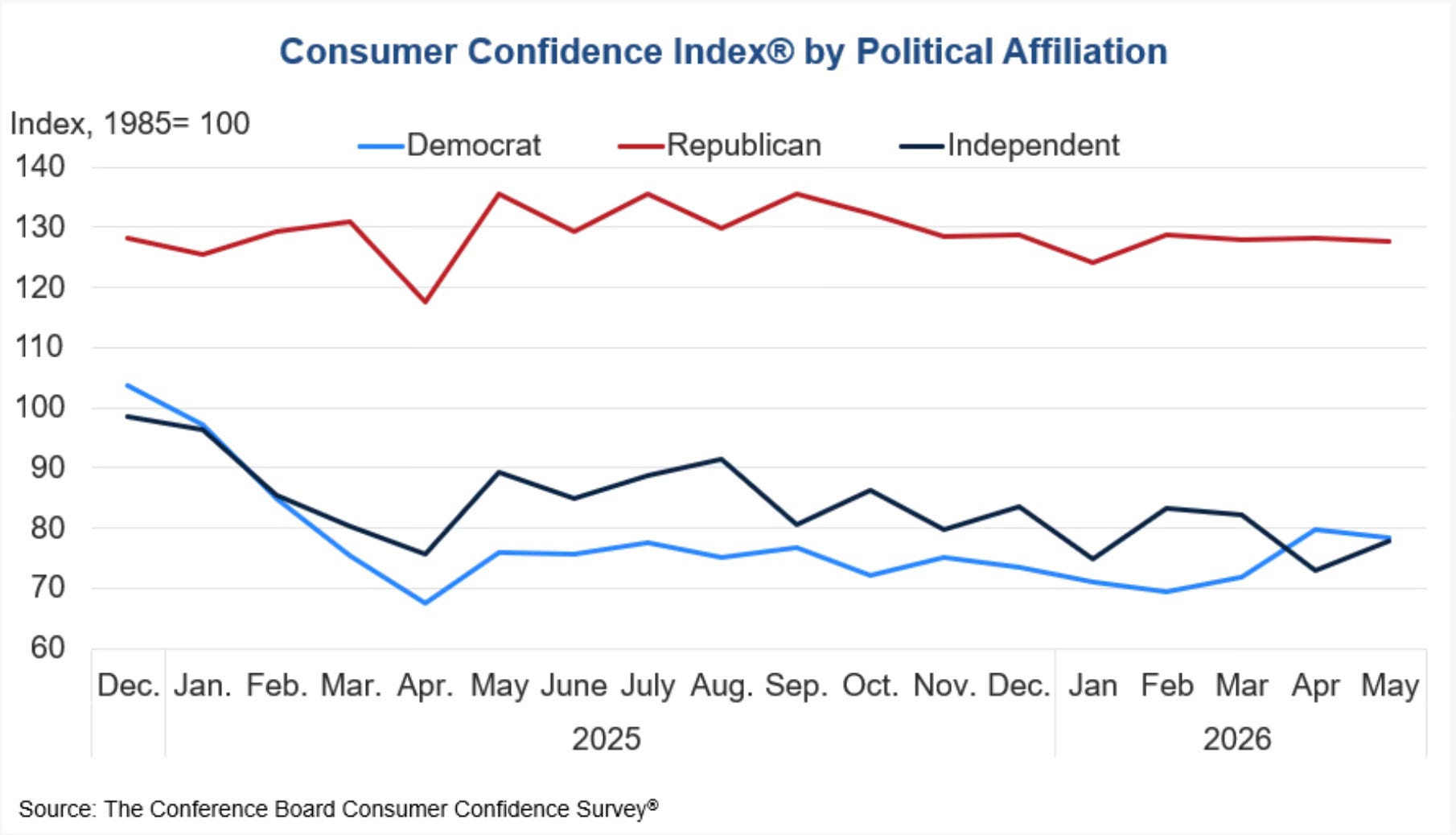
In the April 2026 survey, respondents affiliated with the Democratic Party and Independents scored a Confidence Index nearly 50 points (that is almost 40%) below Republicans. The enormous gap compels the conclusion that the Conference Board survey (and likely the Michigan survey also) mostly measures the impact of political affiliation and not even remotely measures apolitical consumer assessment of their financial situation or the economy. The survey’s numerical scores seem to be an average of two very different and politically skewed sub-surveys of blue and red, not purple.
The huge impact of political affiliation brings to mind the folly of political polling. Political polling (and possibly consumer surveying) is a big business with a questionable reason to exist. A long history of polling misadventures raise doubt whether the Conference Board and University of Michigan survey results say very much about the intentions of the people surveyed. The names Hillary Clinton, Thomas Dewey, and Alf Landon come to mind. (Google is your friend if Landon is an unfamiliar name.)
Consumers Are Not Economists, Perhaps Thankfully
Methodological differences and political warping are not the only reasons for us to wonder whether the monthly headline cycle should bypass these surveys. Consumers arguably are competent to forecast their own behavior in the near-term, although impulses, insecurity, envy, and avarice (an unabashed link to my wife’s writings on financial mental health) undoubtedly undermine these forecasts. Few consumers, however, are aware of even superficially, much less competent to assess, macroeconomic dynamics, such as inflation, interest rates, or the performance of the U.S. economy. No doubt the nation is better served by concentrating econometric intelligence to a small group of academics, but the wafer thin understanding among consumers of inflation, interest rates, treasury bond yields, tariffs, and the like makes a consumer survey on these topics of questionable validity.
Are The Surveys Undermined By Social Media
No genuine opposition can be posed to the notion that social media have vastly altered the polarity of opinion. Social media are platforms with broad reach on which nearly any voice can achieve enormous following with no more than the pulpit provided by a mobile phone. The ease of publishing opinion and the algorithms that channel opinion to viewers already attuned to the opinion content have created tall and narrow silos of attention. Like minds are concentrated in ever more homogenous online communities.
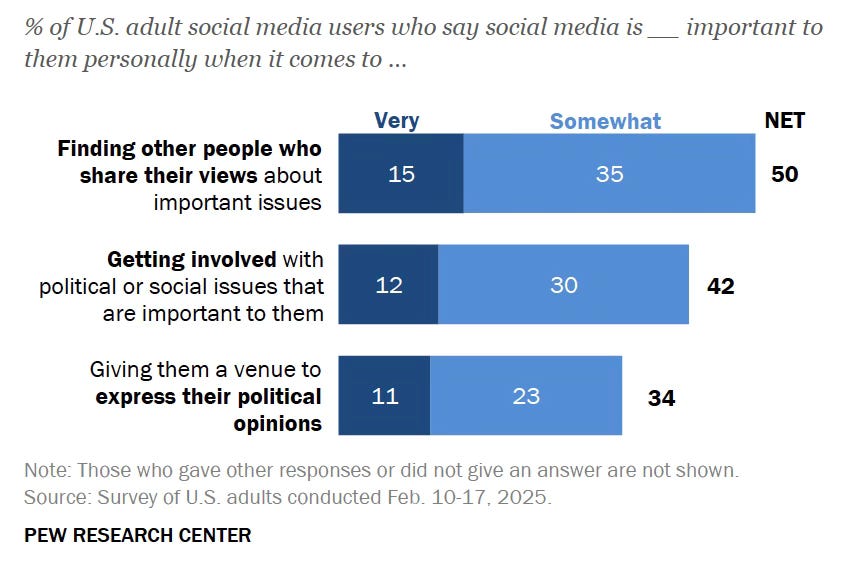
The consumers surveyed by the Conference Board and University of Michigan certainly are among these highly segregated opinion groups. The surveyed consumers surely are bombarded by intense and frequent messages about political parties, the causes of inflation, the unaffordability of housing, the blame for high interest rates, or the threat of AI to employment, among many other opinions. We must wonder whether consumer survey results are increasingly skewed by the ever expanding dominance of social media “influencers” and self-appointed experts.
Why Does This Matter?
The obscured methodologies, small sample sizes, politically warped responses, enormous disparity between results, and inspection of uninformed macroeconomic consumer opinion make the Conference Board and University of Michigan surveys of questionable value. Our assessment at Shovel To Keys is that these surveys and polls generally are a theatrical distraction from data that actually measures the performance of the economy and consumer behavior. Distractions are highly undesirable when problems like housing affordability (often dubbed a crisis) is on the agenda.
We encourage focus on objectively measurable data because policy decisions already are difficult and controversial. If housing policy is misguided by low-value surveys, the credibility and efficacy of policy will diminish. So, Shovel To Keys likely will not talk about consumer sentiment and confidence surveys except where humor can be found in them or to remind us that the delivery of affordable housing cannot be guided by misguided surveys.